
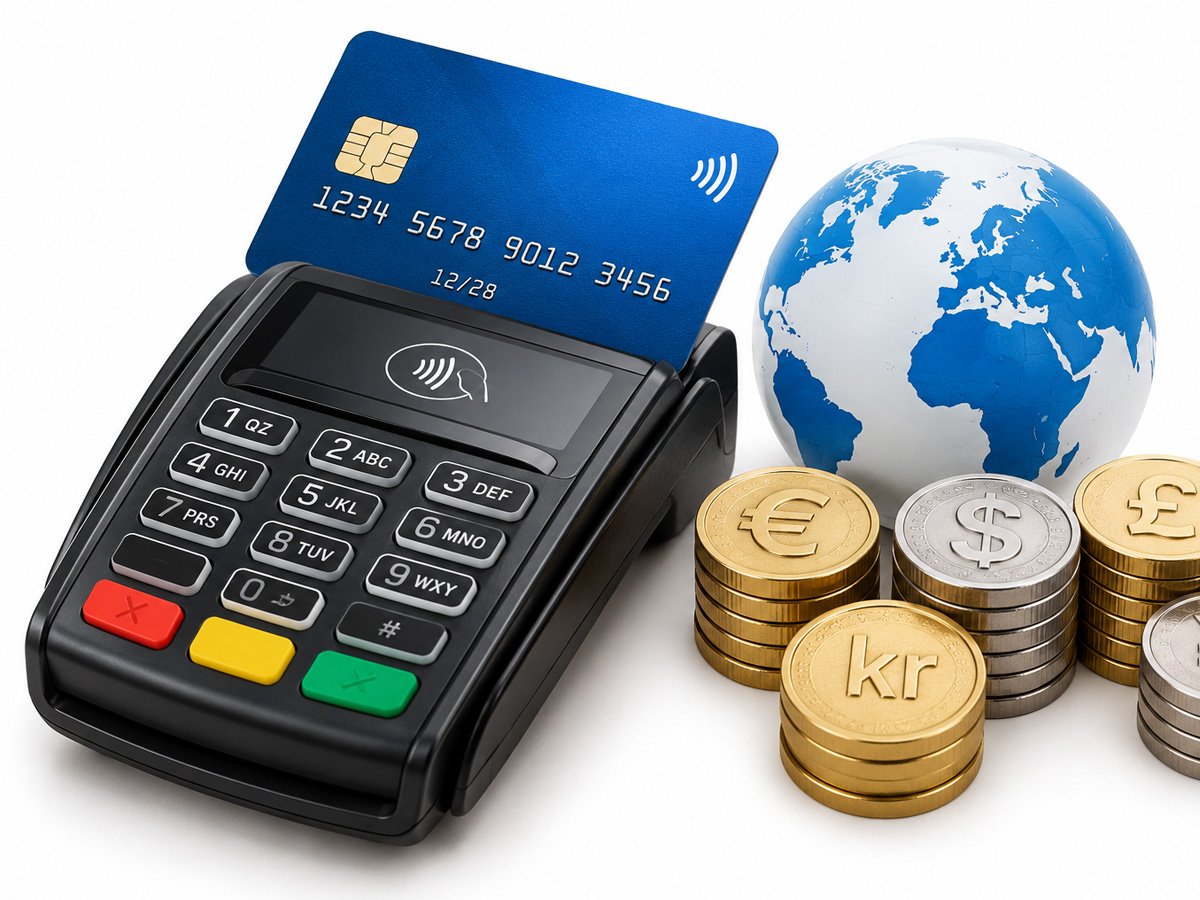
A currency conversion fee, known as "valutapåslag" in Norwegian, is a percentage your card issuer may add when you pay in a foreign currency. This means a purchase can cost more in Norwegian kroner than the amount shown in a currency converter. The fee may be included in the exchange rate rather than appearing as a separate charge on your statement.
To understand what you actually pay, you need to distinguish between the exchange rate used, your card's currency conversion fee and any conversion offered by the payment terminal.
Why is your card's exchange rate different from Norges Bank's rate?
Norges Bank publishes mid-market exchange rates, which represent the midpoint between buying and selling rates in the interbank market at a particular time. These rates are indicative and are not binding on banks. They provide a reference for comparison, not a guaranteed rate for your card purchase.
Card payments may use a different starting rate. For example, DNB and Nordea describe their conversion rates as a rate supplied by Visa or Mastercard, with the bank's currency conversion fee added.
The difference between your card's rate and Norges Bank's rate is therefore not necessarily just the bank's fee.
How to calculate the currency conversion fee
Suppose you buy something for EUR 100. The card network's exchange rate before the bank's fee is NOK 12.00 per euro, and your card has a 2% currency conversion fee. These figures are an example, not current exchange rates.
Before the fee, the purchase costs NOK 1,200. The fee adds NOK 24, bringing the total to NOK 1,224:
EUR 100 × 12.00 × 1.02 = NOK 1,224
In this example, you pay NOK 12.24 per euro after the fee.
A 2% fee adds NOK 200 for every NOK 10,000 you spend, calculated before the fee. The total cost therefore depends on how much you spend in foreign currencies, not just the size of any individual purchase.
How to check the exchange rate on your statement
Find the foreign-currency amount on your receipt and the final NOK amount charged to your account. For a purchase without separate charges, divide the amount in kroner by the amount in the foreign currency.
Using the same example:
NOK 1,224 / EUR 100 = NOK 12.24 per euro
You can use our currency converter to calculate a comparison amount based on Norges Bank's rate for a previous date. Our euro exchange rate page also provides historical EUR/NOK rates.
However, do not assume that the entire difference is your bank's currency conversion fee. The card network's underlying rate may differ from Norges Bank's reference rate. For a more precise check, use Visa's or Mastercard's currency converter and enter the fee shown in your card's price list. Make sure you do not add the fee twice if it is already included in the rate you are comparing.
The exchange rate date matters too. Visa states that it normally uses the rate applicable when the payment is authorised, but may use the rate at processing when this is not possible. Do not automatically assume that the date the transaction is posted to your account is the date used for currency conversion. Ask your bank which rate and date were applied if the figures do not match.
Should you pay in Norwegian kroner or the local currency?
When a payment terminal or ATM offers to charge you in Norwegian kroner, seeing the NOK amount immediately can seem convenient. But you are being offered a separate currency conversion service, often called dynamic currency conversion, or DCC.
By accepting it, you agree to the conversion offered by the merchant or ATM rather than the usual conversion through your card.
The Norwegian Consumer Council recommends choosing the local currency when paying by card or withdrawing cash abroad. Accepting conversion into Norwegian kroner is usually more expensive. When the choice concerns currency conversion, selecting "No conversion" lets you decline the offered conversion into NOK.
Choosing the local currency does not remove your card's own currency conversion fee. You are declining the merchant's or ATM's conversion, not necessarily avoiding all conversion costs. Even so, paying in the local currency is normally the cheaper option.
Does "fee-free card spending" mean currency conversion is free?
Not necessarily. A card's price list may show no transaction charge for purchases while still including a currency conversion fee. These are two different costs.
Cash withdrawals may also involve a withdrawal fee charged by your bank and a separate fee charged by the ATM operator.
When comparing cards or checking a purchase, look at the total amount you pay. Check the currency conversion fee in your card's price list, the currency in which the transaction was charged and any separate charges.
A receipt showing Norwegian kroner is not, by itself, evidence that you received a good exchange rate.