
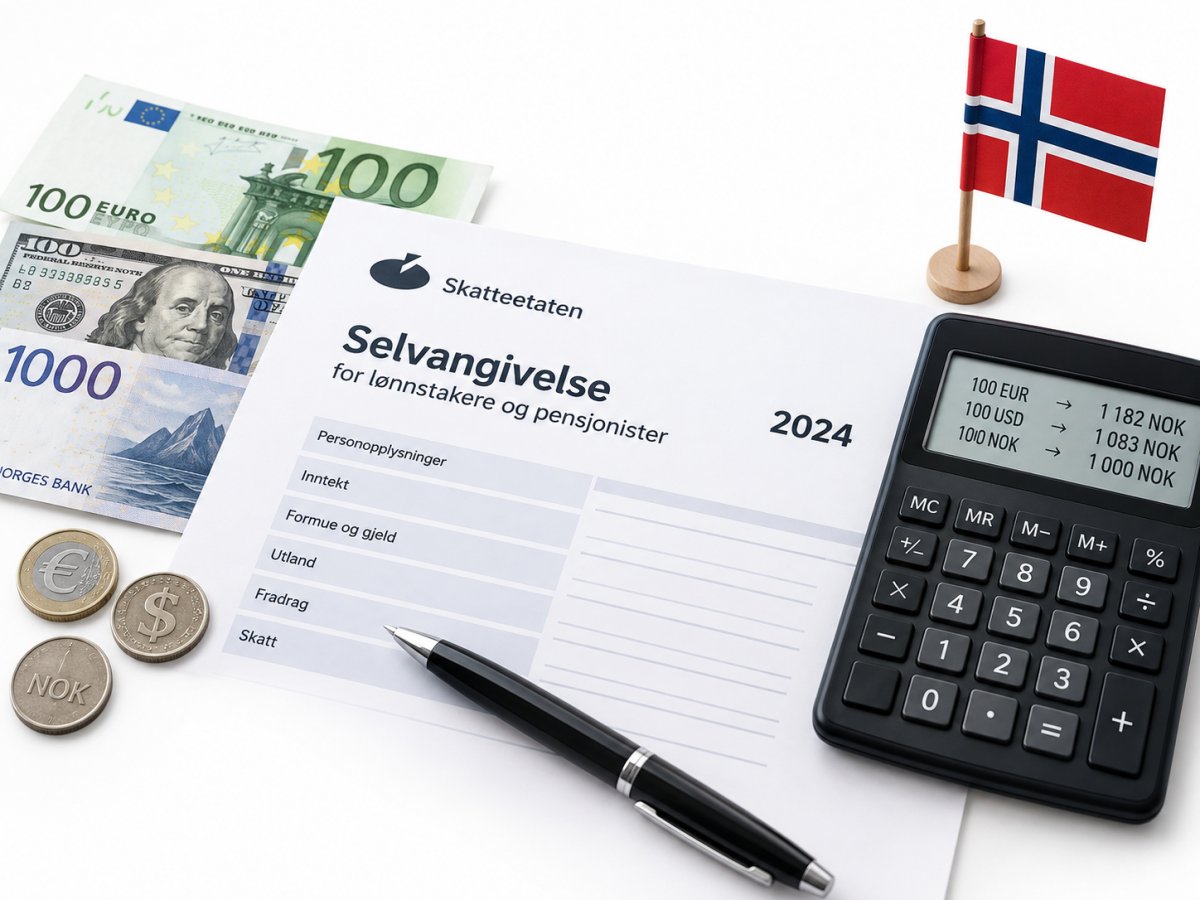
Exchange Rates in the Norwegian Tax Return: Which Rate Should You Use?
If you have income, money in a bank account, shares or other assets in a foreign currency, the amounts generally need to be reported in Norwegian kroner in your tax return.
But which exchange rate should you use?
It depends on what you are reporting. In some cases, you should use the exchange rate on the transaction date. In others, the annual average rate or the rate at year-end is the correct choice.
Which exchange rate applies?
As a simple overview:
What are you reporting? Which exchange rate should be used?
- Income and expenses: Daily exchange rate or annual average rate
- Interest income from abroad: Annual average exchange rate
- Assets and debt: Exchange rate at year-end
- Foreign bank account: Balance at year-end
- Purchase and sale of foreign shares: Exchange rate on the purchase and sale dates
In other words, there is no single "tax exchange rate" that applies to everything.
Income in euros, dollars or another currency
If you receive salary, pension or other income in a foreign currency, the amount normally needs to be converted into Norwegian kroner.
For individuals, income and expenses can in many cases be converted either using the exchange rate on the transaction date or the annual average exchange rate.
For example, if you receive your salary in euros every month, it may be easier to use the average exchange rate for the whole year rather than converting each payment separately.
Interest from foreign bank accounts
If you have a bank account abroad and receive interest in EUR, USD or another currency, the annual average exchange rate is normally used when converting the interest income into NOK.
This applies to the interest income itself. The balance in the bank account is treated as an asset and follows different rules.
Foreign bank accounts and other assets
When reporting assets or debt in a foreign currency, the value at year-end is what matters.
The Norwegian Tax Administration uses the exchange rate as of 1 January of the year following the income year. If no exchange rate is available for that date, the last available rate from the income year can be used.
For example, if you have EUR 10,000 in a foreign bank account at the end of the year, the balance should be converted into NOK according to the rules for assets. In this case, you should not use the annual average exchange rate.
Foreign shares
When buying and selling shares in a foreign currency, the transaction dates are important.
The purchase price is converted into NOK using the exchange rate on the purchase date, while the sale value is converted using the rate on the sale date.
For example:
You buy shares for USD 1,000 and later sell them for USD 1,200. The two amounts should be converted into NOK using the exchange rates that applied on the respective purchase and sale dates.
This also means that changes in USD/NOK can affect the gain or loss measured in Norwegian kroner.
What if there is no exchange rate for the date?
Norges Bank does not publish new exchange rates every calendar day. There may therefore be no new rate on weekends or public holidays.
For assets and debt, the last available exchange rate from the income year can be used if there is no rate available on 1 January.
On valuta-kurser.no, you can look up historical Norges Bank exchange rates going back to 2001 and find the rate around the date you need.
Average exchange rate or daily rate?
A simple rule of thumb is:
Use the average exchange rate when the rules allow it for income received over a longer period. Use the daily exchange rate when a specific transaction or date is important.
On valuta-kurser.no, you can find both historical daily exchange rates and monthly and annual average rates.
The Norwegian Tax Administration can also do the conversion
In several parts of the tax return, you can enter the amount directly in the original currency. The Norwegian Tax Administration will then convert it into Norwegian kroner automatically.
You therefore do not always need to calculate the exchange rate yourself.
However, it can still be useful to look up the rate if you want to check the amount or need to make the calculation manually.
In short
The exchange rate you should use in your tax return depends on what you are reporting.
Income and expenses can often use either a daily exchange rate or an annual average rate. Interest income normally uses an average rate, while assets and debt are converted using the rate at year-end.
For purchases and sales of foreign shares, the exchange rate on each transaction date is used.
If you are unsure which rule applies to your situation, you should check the relevant guidance from the Norwegian Tax Administration.